
If you’ve recently started using Google Analytics 4 (GA4), you’ve probably noticed three metrics appearing throughout almost every report: Users, Sessions, and Events.
At first glance, they might seem similar. After all, they all relate to website activity. However, each measures something different, and understanding these differences is essential for making informed marketing decisions.
Many beginners mistakenly compare users with sessions or assume that every session belongs to a different person. Others focus only on page views and overlook the events that truly reveal how visitors interact with a website.
In this blog, you’ll learn what Users, Sessions, and Events mean in GA4, how they differ, and when each metric should guide your decisions.
Why Understanding These Metrics Matters
Imagine your website received 1,000 Users, 1,800 Sessions, and 9,500 Events. Is that good? Without understanding these metrics, the numbers don’t tell you much.
Once you understand them, you can answer questions such as:
- Are people returning to my website?
- Which visitors engage the most?
- Which marketing channels drive meaningful interactions?
- Are users completing important actions like form submissions or purchases?
Analytics becomes valuable when it helps you answer business questions, not just collect data.
What is a User in GA4?
A User represents an individual person who visits your website or app. For example, John visits your website today, tomorrow, and next week. GA4 may still count him as one user when it can recognize those visits as belonging to the same user.
Think of Users as:
How many people visited my website?
Example:
| Visitor | Users |
| John | 1 |
| Sarah | 1 |
| Alex | 1 |
Total Users = 3
Users help you understand your audience size.
What is a Session?
A Session is a visit. When someone visits your website, GA4 starts a session. One user can have many sessions.
Example:
- Monday: John visits your website → Session 1
- Wednesday: John comes back → Session 2
- Friday: John visits again → Session 3
Users = 1 | Sessions = 3
This is why Sessions are usually higher than Users.
Sessions answer:
How often are people visiting my website?
What is an Event?
Events are where GA4 becomes powerful. An event represents an interaction or occurrence that GA4 records about a user.
Examples include:
- page_view
- scroll
- click
- file_download
- video_start
- form_submit
- purchase
Suppose John visits your website. He views the homepage, clicks a CTA, scrolls down, downloads a guide, and submits a contact form. GA4 can record multiple events from a single session.
This tells you what users actually do, not just that they visited.
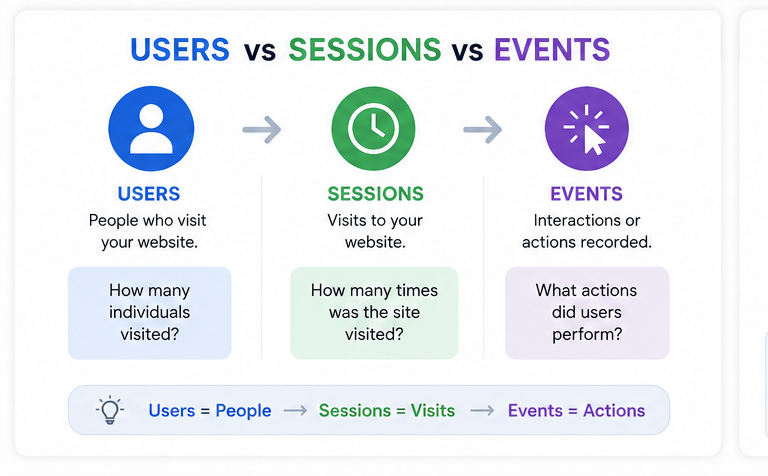
Users vs Sessions vs Events
| Metric | Measures | Business Question |
| Users | People | How many individuals visited? |
| Sessions | Visits | How many times was the site visited? |
| Events | Interactions | What actions did users perform? |
A simple way to remember this: Users = People → Sessions = Visits → Events = Actions
A Real-Life Example
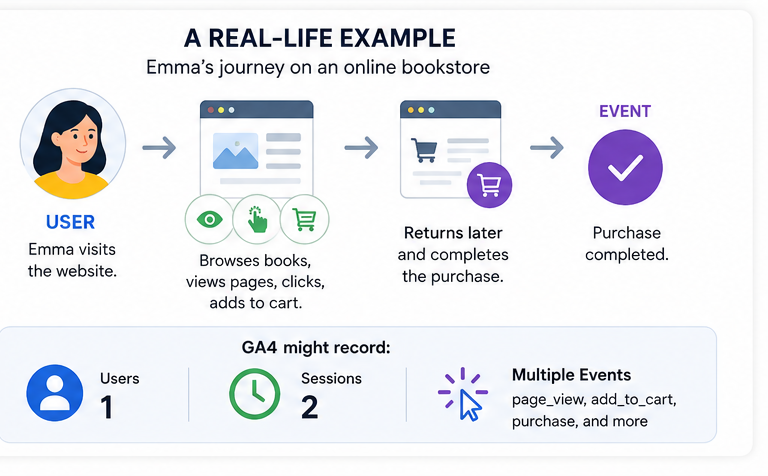
Imagine you own an online bookstore. Today, Emma visits your website, browses five books, adds one to her cart, and leaves without buying. Later that evening, she returns and completes the purchase.
GA4 might record:
- Users = 1
- Sessions = 2
- Multiple events such as page_view, add_to_cart, and purchase
This level of detail helps marketers identify where customers drop off and what encourages them to return.
Why Events Matter More Than Page Views
Older analytics approaches often placed heavy emphasis on page views. GA4 shifts the focus toward user behavior.
Instead of asking only, “How many people viewed this page?”, you can ask:
- Did users scroll?
- Did they watch the video?
- Did they click the CTA?
- Did they download the guide?
- Did they purchase?
These actions provide richer insights into user intent.
Common Beginner Mistakes
Mistake 1: Comparing Users with Sessions
These metrics measure different things, so they should not be treated as interchangeable.
Mistake 2: Looking Only at Page Views
Events provide a clearer picture of engagement and important user actions.
Mistake 3: Ignoring Returning Visitors
If sessions are higher than users, it means visits are occurring beyond the unique users counted. Returning behavior can be an important part of understanding engagement.
Mistake 4: Tracking Everything but Measuring Nothing
Collect events that help answer your business questions. More data is not automatically better data.
Which Metric Should You Focus On?
There isn’t a single “best” metric. Instead:
- If you want to understand audience growth → Users
- If you want to understand website visits → Sessions
- If you want to understand engagement or conversions → Events
The best marketers don’t rely on one metric. They combine all three to understand the customer journey.
Which Metric Should You Focus On?
There isn’t a single “best” metric. Instead:
- If you want to understand audience growth → Users
- If you want to understand website visits → Sessions
- If you want to understand engagement or conversions → Events
The best marketers don’t rely on one metric. They combine all three to understand the customer journey.
Key Takeaways
Users: People who visit your website.
Sessions: Visits to your website.
Events: Actions or interactions recorded during those visits. Understanding these metrics helps you move beyond reporting numbers and start making smarter marketing decisions.
Can one user have multiple sessions?
Yes. A single user can visit your website many times, creating multiple sessions.
Can one session contain multiple events?
Yes. A session may include many events such as page views, clicks, downloads, and purchases.
Why are sessions usually higher than users?
Because visits can occur multiple times for the same user.
Are page views events in GA4?
Yes. In GA4, a page view is recorded as an event called page_view.
Which metric is most important?
It depends on your objective. Users measure audience size, sessions measure visits, and events measure interactions. Together they provide a fuller picture of website performance.
Google Analytics 4 is designed to measure behavior, not just traffic. Users, Sessions, and Events each tell a different part of the story. By understanding how they work together, you can answer meaningful business questions, improve marketing performance, and make decisions based on evidence rather than assumptions.
